
Award Compliance Across Multi-Location Operations: Reduce Payroll Risk and Keep Rules Consistent

Award compliance gets harder when every site works a little differently.
For multi-location businesses, payroll compliance is not just about paying people on time. It is about applying the right rules at the right site, for the right shift, under the right award or agreement. In Australia, awards are legal documents that set minimum pay rates and conditions of employment alongside the National Employment Standards. That means businesses operating across multiple locations need payroll processes that are accurate, consistent and easy to control.
“Awards are legal documents that outline minimum pay rates and conditions of employment.”
Source: Fair Work Ombudsman, Awards
Where multi-location operations start to go wrong
Compliance issues usually begin when local practices drift. One site may apply weekend penalty rates correctly, while another misses them. One team may handle allowances properly, while another overlooks them. For employers managing dispersed teams, one blanket payroll setup is often not enough.
Penalty rates get missed when payroll rules are applied differently across business sites.
Allowances get overlooked when pay conditions are handled differently across local teams.
Public holiday rules vary across states and territories, including substitute public holidays.
Agreement interpretation becomes risky when the underlying award framework is not considered properly.
What better compliance control should do
Good compliance processes should do more than calculate pay. They should help businesses apply the correct rules consistently across every site, role and roster.
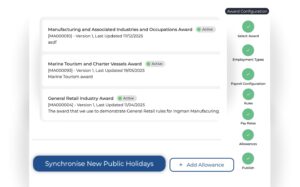
That means businesses need to:
- Map employees to the right award or agreement
- Apply the correct classification and pay conditions
- Account for site-specific public holiday rules
- Manage penalty rates, allowances and engagement rules properly
- Keep a clear audit trail behind payroll decisions
When those rules sit within one central framework, HR can control interpretation, payroll can improve calculation accuracy, and site managers can work within approved settings instead of making judgment calls on the fly.
Why strong records matter
Clear records are part of compliance, not an admin extra. Employers must keep time and wages records for 7 years and issue pay slips within 1 working day of payment.
For larger employers, records support audit readiness, underpayment reviews and stronger governance across multiple locations. Having records is one thing. Being able to access them quickly, trace decisions clearly, and apply the same logic across every site is another.
Businesses with centralised systems are in a stronger position to resolve discrepancies earlier, respond to payroll questions faster and reduce the risk of local process gaps becoming broader compliance issues.
Less guesswork. Better control.
For multi-location businesses, award compliance should be built into day-to-day operations, not fixed later. Standardised rules, accurate payroll settings and strong documentation are what reduce payroll risk and keep operations consistent as a business grows.
Businesses reviewing their current setup should ask whether they have enough visibility, consistency and control across every site. Where teams are still relying on fragmented systems or manual workarounds, it becomes harder to maintain compliance with confidence.
Bring Multi-Site Compliance Into One System
Timecloud helps businesses centralise workforce management, payroll inputs and operational processes so teams can work from the same approved rules across every location.
If your business is managing payroll, rostering and compliance across multiple sites, Timecloud can help reduce manual admin, improve consistency and give your team stronger control over day-to-day operations.